Why your mood changes during the day
By Maxim Dremin, maker of Dayfuku · Published
The short answer
On average, mood follows a daily rhythm: it’s usually best in the morning, dips through the afternoon and is lowest late at night. Researchers think the body clock and sleep play a big part, and on top of that comes what you’re doing, like commuting, working or seeing friends. Your own rhythm can differ, and the easiest way to see it is to check in two or three times a day for a couple of weeks.
If you’ve ever felt fine at 10 in the morning and oddly flat by 10 at night, with nothing in particular going wrong in between, you’re not imagining it. Mood has a daily rhythm, and for most people it runs the same way.
What the research shows
Two very large studies, done in completely different ways, found a similar shape.
- Surveys of 49,000 adults in England. Researchers at University College London looked at almost a million answers collected between 2020 and 2022, during the COVID-19 pandemic, each stamped with the time it was given. On average, people felt best soon after waking, and depressive and anxiety symptoms were highest around midnight. The differences were small and clearest at weekends.
- Half a billion tweets. A study in Science scored the words in tweets from 2.4 million people in 84 countries. Positive words peaked in the morning and fell through the working day, before picking up a little in the evening, in many different cultures. On weekends the morning peak came about two hours later, which fits people sleeping in.
How mood moves through an average day


~1M
time-stamped survey answers from 49,000 adults
Bu, Bone & Fancourt, 2025
509M
tweets from 2.4 million people in 84 countries
Golder & Macy, 2011
+2 hours
how much later the morning peak came on weekends
Golder & Macy, 2011
Both studies show averages across many people, not a rule for everyone. And neither can say exactly what causes the pattern. But “things look better in the morning” holds on average, even if only by a little.
What drives it
Your body clock and sleep
The leading explanation is biological. The body clock runs on a roughly 24-hour cycle that affects alertness, energy and hormones like cortisol, which peaks shortly after waking. On top of that, the longer you’ve been awake, the more tired you get. The weekend shift in the tweet study points the same way: the peak came about two hours later, which the authors read as people sleeping in.
That’s also why the pattern differs between people. Night owls may feel their best later in the day, and a bad night can flatten the morning peak completely.
What you’re doing
The other half is what fills your day. In a study where people reconstructed their previous day episode by episode, commuting and working were among the least enjoyable activities, while socializing, relaxing and eating were among the most. So if your afternoons are meetings and your evenings are a long commute, that shapes your daily curve as much as your body clock does.
What you think about
Evenings are often when people stop being busy and start going over the day. For some that’s a nice wind-down; for others it’s when worries come back. Being tired makes the second more likely.
Why one entry at night hides all of this
Most mood journals ask for one entry a day, usually in the evening. That records one point on the curve, and it’s the low one for most people.
It also records a summary, and summaries are unreliable. When we look back on an experience, we judge it mostly by its most intense moment and by how it ended, a pattern psychologists call the peak-end rule. A day that ended well tends to be remembered as better than it was. The rough morning, and whatever turned it around, never makes it into the journal.
Checking in a few times a day avoids both problems. Each entry is how you feel right now, which is easier to answer honestly than “how was today?”, and together they show the shape of the day. That’s the idea behind a mood tracker you can use several times a day.
How to find your own pattern in two weeks
- Pick two or three moments, for example after waking, mid-afternoon and before bed. Keep them roughly the same each day.
- Check in at each one with your mood on a simple five-point scale and one word about what you were doing.
- Do it for two weeks. That gives you about ten or more entries for each time of day, enough to compare.
- Compare the times. Is your afternoon average clearly lower than your morning? Do evenings look different on weekends?
- Look at what sits next to the dips. If afternoons are low on workdays but fine on weekends, the dip may be about work, not the time itself.
Then try one small change, like a short walk after lunch or going to bed half an hour earlier, and check again after another two weeks.
| If you notice… | It might be… | Something to try |
|---|---|---|
| Mornings are low, evenings fine | Short or poor sleep, or being a night owl | Check your sleep for a week; a later start on free days |
| A dip every afternoon | Tiredness after lunch, or a draining part of the workday | A short walk or daylight break, then compare |
| Evenings are your lowest point | Tiredness and going over the day | An earlier, calmer wind-down routine |
| Weekdays low, weekends fine | Work or the commute | Note what exactly you were doing during the dips |
| No clear pattern | Your mood follows events more than the clock | Look at activities and people instead of times |
When to talk to someone
Ups and downs within a day are normal. But if your mood is low most of the day for two weeks or more, if mornings are consistently the hardest part and it’s getting worse, or if your mood swings get in the way of work, sleep or relationships, talk to a doctor. A few weeks of check-ins can be a useful thing to bring along.
Seeing your daily rhythm in Dayfuku
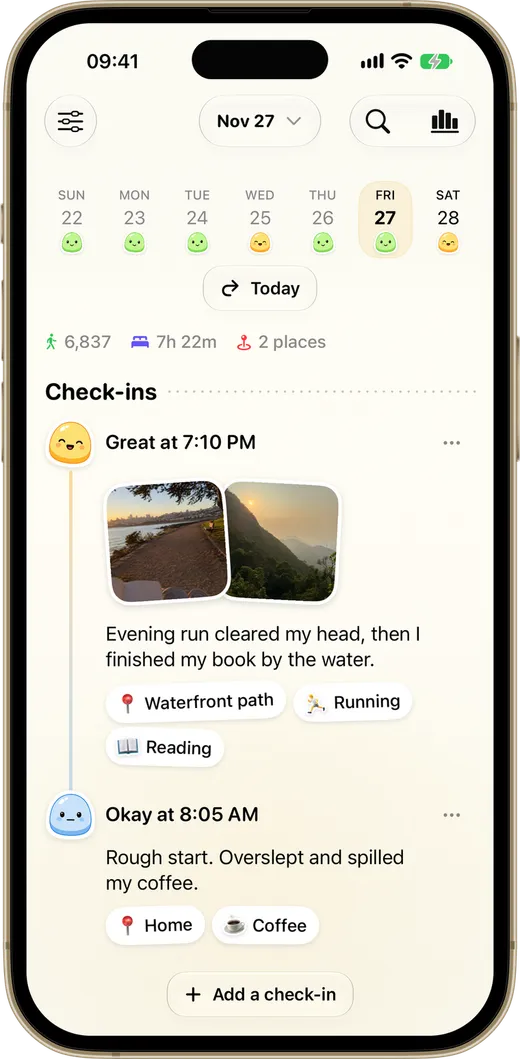
Dayfuku is built for this kind of tracking. Each check-in takes one tap and keeps its own time, so a day can hold a morning, an afternoon and an evening entry. The day page lines them up in order, and the Home Screen widget lets you check in without opening the app. With Dayfuku Pro, Insights also tell you which part of your day usually feels best, and which activities tend to come with your better and rougher days.

Questions people ask
What time of day are people happiest?
On average, soon after waking. In a study of adults in England with almost a million survey answers, collected during the COVID-19 pandemic, people reported the best mood and life satisfaction in the morning and the most depressive and anxiety symptoms around midnight. The differences were small, though, and your own peak may be later.
Why do I feel worse in the evening?
Tiredness is the most common reason: as the day goes on, the body clock and the hours you’ve been awake both pull mood down. Evenings are also when many people stop being busy and start thinking over the day. If you only feel low late at night, it often helps to look at your sleep first.
Is it normal for mood to change several times a day?
Yes. Mood reacts to sleep, food, people, work and what happens to you, so a few ups and downs in a day are normal. Swings that are very strong, last for days, or get in the way of daily life are worth talking to a doctor about.
How can I find out when I feel best?
Check in two or three times a day at roughly the same times, for example morning, afternoon and evening, for two weeks. Then compare your average mood at each time. Ten or more check-ins per time slot is enough for a first rough comparison.
Sources
- Bu, F., Bone, J. K. & Fancourt, D. (2025). Will things feel better in the morning? A time-of-day analysis of mental health and wellbeing from nearly 1 million observations. BMJ Mental Health, 28(1), e301418.
- Golder, S. A. & Macy, M. W. (2011). Diurnal and seasonal mood vary with work, sleep, and daylength across diverse cultures. Science, 333(6051), 1878–1881.
- Kahneman, D. et al. (2004). A survey method for characterizing daily life experience: The day reconstruction method. Science, 306(5702), 1776–1780.
- Redelmeier, D. A. & Kahneman, D. (1996). Patients’ memories of painful medical treatments: real-time and retrospective evaluations of two minimally invasive procedures. Pain, 66(1), 3–8.
This guide is general information, not medical advice. If your mood is low most days, or you’re thinking about harming yourself, please talk to a doctor or contact a local crisis line.