How to track your mood (and actually stick with it)
By Maxim Dremin, maker of Dayfuku · Published
The short answer
Rate how you feel on a simple five-point scale, add one thing about what you were doing, and do it at moments that already happen every day, like after coffee or before bed. Keep each entry under a minute, don’t worry about missed days, and look back once you have three or four weeks of entries. That’s when patterns start to show.
Many people who start a mood journal stop within a few weeks. Usually not because it didn’t help, but because it asked too much: a long entry every night, a scale with too many options, a streak that broke and felt like failure. The way to keep going is to make each entry so small that it still happens on a tired, busy day.
What a mood check-in needs
A useful entry has two parts.
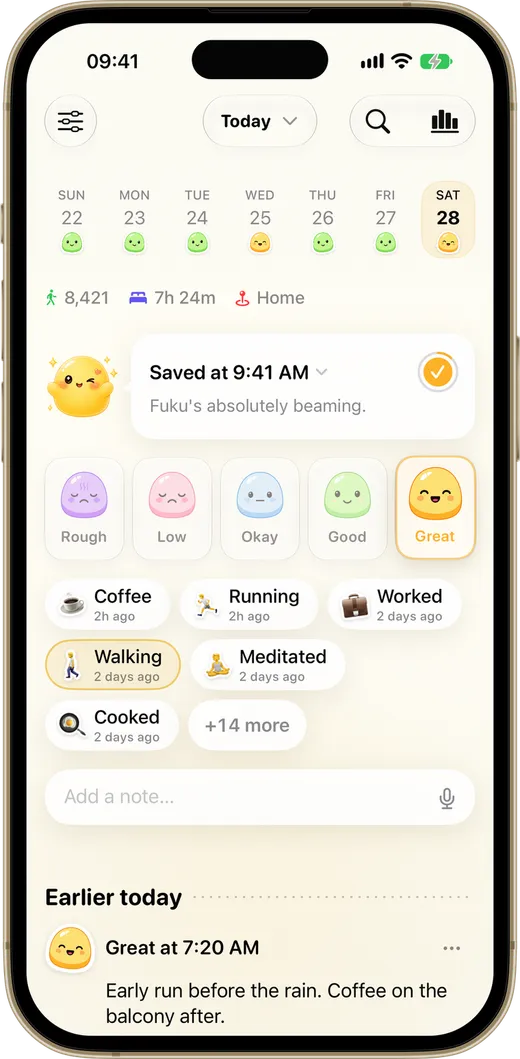
- How you feel right now, on a simple scale. Five steps, like rough, low, okay, good and great, are enough. With ten, you spend time deciding between a 6 and a 7, and the difference doesn’t mean much later.
- One piece of context: what you were doing, where you were, or who you were with. “Work”, “walk”, “friends”, “bad sleep”. This is what turns a list of moods into something you can learn from.
-
 Rough
-
 Low
-
 Okay
-
 Good
-
 Great
Everything else is optional. Write a note or take a photo when something stands out, and skip it the rest of the time. A short honest entry beats a long one you dread writing.
Pick moments that already happen
The easiest way to remember is to attach the check-in to something you already do every day:
- after your first coffee,
- when you sit down for lunch,
- on the way home,
- when you get into bed.
Pick one or two to start. A reminder on your phone at those times helps until it becomes automatic.
Once a day or several times?
Once a day is a fine start. But if you only log at bedtime, you mostly record how the day ended: we tend to remember a day that ended well as better than it was. The rough morning, and whatever turned it around, never makes it into the journal. There’s more on why in why your mood changes during the day.
If your mood moves a lot during the day, two to four quick check-ins give a much truer picture. See a mood tracker you can use several times a day for how that works.
How to keep going after the first week
Make it take seconds. If logging means opening a notebook, finding a pen and writing a paragraph, it won’t survive a hard week. One tap for the mood and one for an activity is the goal.
Don’t treat a missed day as a failure. A well-known study followed 96 volunteers as they turned a new daily behavior into a habit:
66 days
for a new daily habit to feel automatic, for the typical person
Lally et al., 2010
18–254 days
the range between people, so a slow start is normal
Lally et al., 2010
1 missed day
made no real difference; only skipping often built weaker habits
Lally et al., 2010
So if you miss a day, or a week, just log today.
Don’t backfill from memory. Reconstructing last Tuesday’s mood on Sunday mostly records how you feel on Sunday. A gap in your journal is more honest than a guess.
Log good moments too. It’s tempting to only write when something is wrong. But to see what helps, you need the good days on the record as well.
Be honest, not fair. Log how you feel, not how you think you should feel given the day. Nobody else reads it.
Paper, notes app or mood tracker app?
Any of them works if you keep using it. Here’s how they compare:
| Paper journal | Notes app | Mood tracker app | |
|---|---|---|---|
| Time per entry | A few minutes | About a minute | A few seconds |
| Reminders | No | Separate app | Built in |
| Finds patterns for you | No, you count by hand | No | Yes, after a few weeks |
| Search old entries | Flip through pages | Text search | By text, mood or activity |
| Adds steps and sleep | No | No | Some apps, from Apple Health |
| Feels personal | Very | Not really | Depends on the app |
Paper is lovely if you enjoy writing and mostly want a record to reread. An app is better if you want to check in quickly during the day and have the counting done for you.
What to look for after a few weeks
After three or four weeks you’ll have enough entries to start looking back. A few questions to ask:
- Which activities show up on your better days, and which on your rougher ones?
- Is there a time of day when you usually feel lower?
- How does this week compare with the last few? Comparing whole weeks smooths out single odd days.
- What did you write on your best days? Rereading notes often explains a pattern faster than a chart.
Treat what you find as a hint, not a verdict. If you log “friends” mostly on weekends, it may be the weekend that lifts your mood as much as the friends. Patterns tell you where to look; trying a change for a couple of weeks and checking again tells you more.
Why putting it into words helps
There’s a small bonus to all this. In a brain-imaging study of 30 people, choosing a word for the emotion on a face, rather than picking a name for the person or matching the face to another one, lowered activity in the amygdala, a part of the brain involved in emotional reactions. It measured brain activity, not how people felt, but it fits what many people notice: writing down “anxious” or “annoyed” can take a little of the edge off.
That doesn’t make a mood journal a treatment. If your mood is low most days for two weeks or more, please talk to a doctor; a few weeks of entries can be a useful thing to bring along.
Tracking your mood with Dayfuku
We built Dayfuku around the ideas in this guide. The first tap on a mood saves a check-in, your favorite activities are one more tap away, and you can check in from a Home Screen widget without opening the app. You can log as many times a day as you like, reminders come at the times you choose, and nothing happens if you miss a day. Once you have a few weeks of entries, Insights show your mood trends and how often you do each activity, and with Dayfuku Pro, Fuku tells you which activities tend to come with your better days.

Questions people ask
How often should I track my mood?
Once a day is enough to start. If your mood often changes during the day, two to four short check-ins, for example morning, afternoon and evening, show much more than one entry at night. What matters most is that you keep doing it for a few weeks.
What should I write in a mood journal?
Only your mood and one piece of context, such as what you were doing or who you were with, are needed. Add a short note when something stands out. A line like “Long call with Mum, felt lighter afterwards” is more useful later than a paragraph about the whole day.
How long does it take to see patterns in my mood?
Usually three to four weeks of regular entries. Before that, a single good or bad day can easily look like a pattern. Comparing whole weeks with each other is more reliable than comparing single days.
What if I forget to log my mood for a few days?
Just start again with today. In habit research, missing a single day made little difference to how well a habit formed. Don’t try to fill in a week from memory; a gap is more honest than guesses.
Does tracking your mood actually help?
It can help you notice things you’d otherwise miss, like which activities or people tend to come with your better days. Putting a feeling into words may also take a little of its edge off. It isn’t a treatment, though: if your mood is low most days, talk to a doctor.
Sources
- Lally, P. et al. (2010). How are habits formed: Modelling habit formation in the real world. European Journal of Social Psychology, 40(6), 998–1009.
- Lieberman, M. D. et al. (2007). Putting feelings into words: Affect labeling disrupts amygdala activity in response to affective stimuli. Psychological Science, 18(5), 421–428.
- Redelmeier, D. A. & Kahneman, D. (1996). Patients’ memories of painful medical treatments: real-time and retrospective evaluations of two minimally invasive procedures. Pain, 66(1), 3–8.
This guide is general information, not medical advice. If your mood is low most days, or you’re thinking about harming yourself, please talk to a doctor or contact a local crisis line.